Vestibular Unesp · Inglês
Questão 27 da Unesp 2020
1ª fase, Prova de Conhecimentos Gerais, versão 1
Tate Modern - London Hélio Oiticica Until Summer 2019
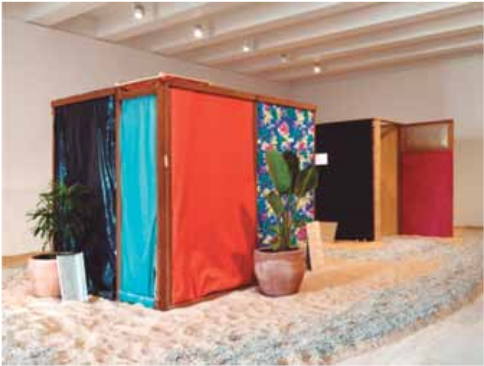
(Hélio Oiticica. Tropicália, Penetrables PN2 "Purity is a myth" and PN3 "Imagetical", 1966-1967.)
Tropicália
Tropicália is used to describe the explosion of cultural creativity in Rio de Janeiro and São Paulo in 1968 as Brazil's military regime tightened its grip on power.
Many of the artists, writers and musicians associated with Tropicália came of age during the 1950s in a time of intense optimism when the cultural world had been encouraged to play a central role in the creation of a democratic, socially just and modern Brazil. Nevertheless, a military coup in 1964 had brought to power a right-wing regime at odds with the concerns of left-wing artists. Tropicália became a way of exposing the contradictions of modernisation under such an authoritarian rule.
The word Tropicália comes from an installation by the artist Hélio Oiticica, who created environments that were designed to encourage the viewer's emotional and intellectual participation. Oiticica called them "penetrables" because people were originally encouraged to enter them. They mimic the improvised, colourful dwellings in Rio de Janeiro's favelas, or shanty towns. The lush plants and sand help to convey a sense of the tropical character of the city. When Oiticica exhibited the work, he also included live parrots.
From its beginning, Tropicália was seen as a re-articulation of Anthropophagia ("cannibalism"), an artistic ideology promoted by Oswald de Andrade.
(www.tate.org.uk. Adaptado.)
De acordo com o texto, a Tropicália
Fonte: Unesp 2020 · Texto-base: (www.tate.org.uk. Adaptado.) / (Hélio Oiticica. Tropicália, Penetrables PN2 "Purity is a myth" and PN3 "Imagetical", 1966-1967.) · Pedir remoção ou avisar erro
- A)
congregou artistas de diversos matizes ideológicos, tanto favoráveis como contrários ao regime militar.
- B)
foi um movimento eminentemente musical, que transmitia o otimismo da década de 1950.
- C)
foi um movimento artístico-cultural que se apropriou do ideário da Antropofagia.
- D)
foi um movimento cultural interrompido pelo regime militar.
- E)
teve seu ápice incentivado pela explosão industrial nos estados do Rio de Janeiro e de São Paulo.
Ver resposta
Resposta: alternativa C
Gabarito oficial da banca.
Mais questões de Inglês · Prova original no site oficial
Monte um simulado da Unesp
Com a conta grátis de aluno, você escolhe as matérias e a quantidade de questões, faz a prova com cronômetro, vê o acerto por matéria e salva o seu progresso. Grátis, para estudantes a partir de 14 anos.